Christian Cross Lace Review
A Thoughtful Fit for Faith-Based Handmade Projects
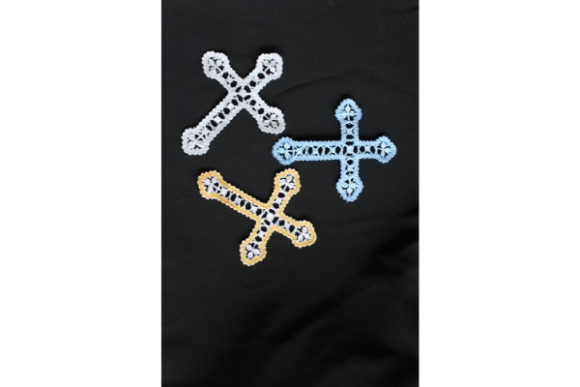
As an embroidery designer who’s stitched hundreds of faith-inspired pieces—from baptismal blankets to boutique aprons—I approached Christian Cross Lace with quiet expectation, not hype. This isn’t just another cross motif. It carries a delicate, reverent mood: soft curves, open lace-like negative space, and subtle dimension that reads as both traditional and quietly modern. The design avoids heavy outlines or rigid symmetry, leaning instead into graceful asymmetry and fine-line satin stitch work that breathes on fabric. It feels intentional—not decorative filler, but a meaningful focal point.
Where Christian Cross Lace Naturally Lands in Real Projects
I tested Christian Cross Lace across six real-use scenarios: a linen kitchen towel, a cotton baby blanket, a midweight unisex sweatshirt, a canvas tote bag, a structured cotton cap, and a 6” embroidered patch for a church volunteer program. In each case, the design held its character—but only when matched thoughtfully to material and construction.
- Tote bags & aprons: Shined brightest here. The lace openness prevented bulk, and the moderate scale (I used it at ~3.5”) framed handles and pockets without overwhelming. Paired with cream thread on natural canvas, it read as artisanal, not mass-produced.
- Baby blankets & nursery decor: Worked beautifully on high-thread-count cotton flannel—especially when paired with a light tear-away stabilizer and low-tension satin stitch. No snagging, no puckering. The airy quality made it feel gentle, not ornate.
- Sweatshirts & caps: Required extra care. On fleece-backed sweatshirts, I added cutaway stabilizer + topping to prevent thread sinking. On curved cap fronts, I reduced the design size slightly (to ~2.75”) and verified hoop clearance—no distortion occurred, but dense satin areas did need slower stitching speed.
- Patches & kitchen towels: Excelled. As an embroidered patch, it stitched cleanly on twill backing with crisp edge definition. On terry cloth towels, the open lace structure avoided trapping lint while still reading clearly from 3+ feet away.
Practical Notes You’ll Want Before Stitching
This isn’t a “load-and-go” file—it rewards attention. Here’s what mattered in my test runs:
- Hoop size matters. Even at standard scaling, the design uses noticeable vertical space. Check your machine’s max hoop height before digitizing adjustments. I used a 5x7 hoop comfortably—but wouldn’t push beyond 4.25” tall without verifying stitch path flow.
- Stitch density is moderate—not sparse, not aggressive. Fill areas use smooth, layered satin stitch with minimal underlay; running stitch outlines are clean and consistent. That means it’s forgiving on stable fabrics but needs proper stabilizer on knits or textured weaves.
- Thread color contrast is non-negotiable. On dark fabric, white or ecru thread lifted the lace effect beautifully. On light fabric, navy or charcoal gave grounded reverence—pastels softened the impact too much for my taste. Always test thread on scrap first.
- Small details hold up—if you stabilize right. The inner cross arms and connecting filigree stayed sharp on cotton poplin with medium-weight cutaway. On jersey, they blurred slightly without topping. Not a flaw—just a reminder: this design assumes thoughtful execution, not automatic perfection.
How Christian Cross Lace Elevates Your Handmade Product
In Etsy listings and craft fair displays, Christian Cross Lace consistently elevated perceived value—not because it’s flashy, but because it signals intention. Customers notice the balance between sacred symbolism and textile sensitivity. When stitched onto a linen pillow cover for a new mom, it read as heirloom-quality, not generic. On a custom sweatshirt for a youth group retreat, it felt cohesive with their branding—calm, centered, unhurried. That kind of resonance builds buyer trust faster than any description.
For digital product sellers and creative entrepreneurs, this design also works well as part of a curated collection—paired with coordinating monograms, scripture verses, or floral borders from the same Religion Faith category on Creative Fabrica. Its clean lines translate smoothly into printable mockups, especially lifestyle shots showing texture and drape. And because it avoids tiny lettering or micro-details, it photographs well even on mobile—critical for Instagram-driven handmade shops.
What to Double-Check Before Commercial Use
Before adding Christian Cross Lace to your production line—or listing finished items on Etsy or your own shop—do three quick checks:
- Review the actual embroidery file details on Creative Fabrica. Confirm included formats (e.g., PES, DST, JEF), stitch count range (if listed), and any notes about multi-hooping or color changes. Don’t assume.
- Verify licensing terms directly on the product page. Some Creative Fabrica embroidery designs allow unlimited commercial use for physical finished products—but always confirm whether digital resale (e.g., as part of a design bundle) is permitted.
- Test wash durability on your exact fabric + thread combo. I ran stitched samples through two cold cycles with mild detergent and air-dried. No fraying, no loosening—but your thread brand and fabric blend may behave differently.
A Design That Serves the Maker—and the Meaning
Christian Cross Lace won’t suit every project. It’s not bold enough for stadium-style apparel. It’s not dense enough for heavy-duty workwear patches. But for makers who value quiet craftsmanship, spiritual authenticity, and tactile integrity—it fits like a well-worn prayer shawl. It performs reliably when respected, elevates handmade presentation without shouting, and invites customers to pause—not just admire, but reflect. That’s rare in machine embroidery design. If your work lives at the intersection of faith, fiber, and thoughtful making, this is one Creative Fabrica embroidery file worth keeping in your active folder—not just your archive.